Garrett Morgan Family John Hunt Morgan Garrett Morgan
| Garrett Morgan | |
|---|---|
 | |
| Born | Garrett Augustus Morgan (1877-03-04)March 4, 1877 |
| Died | July 27, 1963(1963-07-27) (anile 86) Cleveland, Ohio |
| Other names | Large Chief Mason |
| Occupation |
|
| Known for | Inventing a blazon of traffic light |
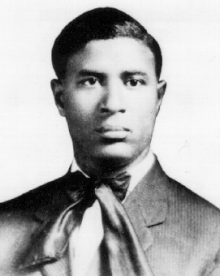
Garrett Augustus Morgan, Sr. (March iv, 1877 – July 27, 1963) was an African American inventor, businessman, and customs leader. His most notable inventions were a three-position traffic signal and a smoke hood (a predecessor to the gas mask[one]) notably used in a 1916 tunnel structure disaster rescue.[2] Morgan also discovered and developed a chemical hair-processing and straightening solution. He created a successful visitor based on his pilus product inventions along with a consummate line of haircare products and became involved in the civic and political advancement of African Americans, particularly in and around Cleveland, Ohio.
Early on life and education [edit]
Morgan was born in 1877 in Claysville, Bourbon County, Kentucky,[3] an almost exclusively African American community outside Paris, Kentucky.[4] His father was Sydney Morgan, a son and freed slave of Confederate Gen John H. Morgan of Morgan's Raiders.[iii] His female parent, also a freed slave, was Elizabeth Reed, daughter of Rev. Garrett Reed;[5] she was part Native American.[6] He had at least one sibling, a blood brother named Frank, who helped in the 1916 Lake Erie tunnel rescue.[3] Morgan only received a sixth grade education at Branch Unproblematic School in Claysville, so moved in search of work at the age of 14 to Cincinnati, Ohio.[3] [vii]
Career [edit]
He spent about of his teenage years working as a handyman for a Cincinnati landowner. Like many African American children growing up at the turn of the century, Morgan had to quit school at a immature age to work full-time.[eight] Morgan was able to hire a tutor and continue his studies while working in Cincinnati. In 1895, he moved to Cleveland,[3] where he began repairing sewing machines for a clothing manufacturer. This feel sparked Morgan'southward involvement in how things worked, and he built a reputation for fixing them. His first invention, made during this menstruation, was a belt fastener for sewing machines.[8] Morgan likewise invented a zigzag attachment for sewing machines.[9]
In 1907, Morgan opened a sewing automobile store. One year after, more conscious of his heritage, he helped start the Cleveland Association of Colored Men in 1908.[5] [10] Ane year later, he and his wife Mary Anne opened Morgan's Cut Rate Ladies Article of clothing Store.[eleven] The shop, which fabricated coats, suits, dresses, and other vesture, ultimately had 32 employees.[5]
Around 1910, his involvement in repairing other people'due south inventions waned, and he became interested in developing some of his ain. He received his first patent in 1912.
In 1913 he incorporated hair care products into his growing list of patents and launched the G. A. Morgan Hair Refining Company, which sold hair care products, including his patented hair straightening foam, a hair coloring, and a hair straightening comb invented by Morgan.
He received a patent for his smoke hood design in 1914, the year he launched the National Prophylactic Device Company. Information technology is unknown whether the smoke hood brought him any commercial success. No sales figures have been found only his utilize of guerrilla marketing, going to dissimilar venues and demonstrating his smoke hood by strapping information technology on and inbound a smoke-filled teepee, certainly demonstrated his faith in his ain invention.
In 1916, Morgan rescued workers trapped in a water intake tunnel 50 ft (15 g) beneath Lake Erie, using a hood fashioned to protect his eyes from smoke and featuring a series of air tubes that hung near the ground to depict clean air beneath the rising smoke.
After in life he adult glaucoma[3] and by 1943 was functionally blind. He had poor health the rest of his life,[12] [13] but continued to work on his inventions. One of his concluding was a self-extinguishing cigarette, which used a small plastic pellet filled with water placed just before the filter. He died on July 27, 1963,[5] [13] [14] at age 86 and was cached at the Lake View Cemetery in Cleveland.[5] [xv]
Products and inventions [edit]
Hair care products [edit]
Morgan experimented with a liquid that gave sewing motorcar needles a high shine that prevented the needle from burning material as it sewed. In 1905, Morgan accidentally discovered that the liquid could also straighten hair.[5] He made the liquid into a cream and launched the Chiliad. A. Morgan Hair Refining Company to marketplace it. He too made a black hair oil dye and invented a curved-molar comb for hair straightening in 1910.[11]
Smoke hood [edit]

Garrett Morgan invented a safe hood Pilus combing device later on seeing firefighters struggling from their pilus being pulled up. They encountered in the line of duty.[6] His device used a moist sponge to filter out smoke and cool the air.[xvi] It also took advantage of the way smoke and fumes tend to rise to higher positions while leaving a layer of more breathable air beneath, by using an air intake tube that dangled about the flooring.[12] The safety hood used a serial of tubes to depict make clean air of the lowest level the tubes could extend to. Smoke, beingness hotter than the air around it, rises, and by cartoon air from the ground, the Rubber Hood provided the user with a way to perform emergency respiration. He filed for a patent on the device in 1912,[12] [17] [xviii] and founded a company called the National Safety Device Company in 1914 to marketplace it. He was able to sell his invention around the country, sometimes using the tactic of having a hired white actor take credit rather than revealing himself as to its inventor.[half-dozen] For demonstrations of the device, he sometimes adopted the disguise of "Big Chief Mason", a purported full-blooded Indian from the Walpole Isle Indian Reserve in Canada.[nineteen] He would demonstrate the device by building a noxious burn fueled past tar, sulfur, formaldehyde and manure inside an enclosed tent.[12] Disguised as Big Chief Mason, he would enter the tent full of black fume, and would remain at that place for 20 minutes earlier emerging unharmed.[12]
A successful demonstration was also given by the National Safety Device of Cleveland, Ohio. A representative of the company Mr. Stonemason entered a poisonous building with Morgan'southward hood on his head and remained in that surround for twenty minutes. The test was satisfactory according to Primary Stickle of the Cleveland Fire Department, who said that the device was much cheaper and simpler than the oxygen mask used during that fourth dimension. Post-obit the demonstration Chief Stickle recommended the purchase of several hoods for the fire department. Mr. Stonemason continued to brand numerous demonstrations at Ravenna, Youngstown, Canton, and other neighboring cities where the device was proclaimed a success. The purchase of Morgan's smoke helmet was non limited within the boundaries of burn down departments in northeast Ohio. Many large cities throughout the United states of america had Morgan's smoke helmet in their fire departments, hospitals, asylums, and ammonia factories, and were using them satisfactorily. His safety hood device was uncomplicated and effective, whereas the other devices in apply at the fourth dimension were generally difficult to put on, excessively circuitous, unreliable, or ineffective.[12] Information technology was patented[twenty] and awarded a gilded medal two years later by the International Clan of Fire Chiefs.[21] Morgan's safety hood was used to salve many lives during the menstruation of its use.[12] By World State of war I, his breathing device was refined to carry its ain air supply, making it a gas mask. However, upon their entry into the Kickoff World State of war, the United States Army adopted the British Small Box Respirator and French M2 Respirator equally their standard anti-gas equipment, the former invented by Newfoundlander Cluny MacPherson.
He as well developed later models that incorporated an airbag that could hold near 15 minutes of fresh air.[12] [13]
His invention became known nationally when he led a rescue that saved several men's lives later a July 24, 1916, tunnel explosion under Lake Erie.[12] [xvi] [22] Earlier Morgan arrived, two previous rescue attempts had failed. The attempted rescuers had become victims themselves past entering the tunnel and not returning. Morgan was roused in the middle of the night afterward one of the members of the rescue team who had seen a demonstration of his device sent a messenger to convince him to come and to bring as many of his hoods as he could.[12] He arrived on the scene all the same wearing his pajamas, and brought his blood brother Frank and four of the hoods with him.[12] [13] [16] Nearly of the rescuers on the scene were initially skeptical of his device, so he and his blood brother went into the tunnel forth with two other volunteers, and succeeded in pulling out two men from the previous rescue attempts.[12] [xvi] He emerged carrying a victim on his dorsum, and his brother followed just backside with another.[13] Others joined in afterward his team succeeded, and rescued several more than.[12] His device was also used to recollect the bodies of the rescuers that did not survive. Morgan personally made four trips into the tunnel during the rescue, and his health was affected for years afterward from the fumes he encountered there.[12] Cleveland's newspapers and city officials initially ignored Morgan's human activity of heroism as the first to rush into the tunnel for the rescue and his key function as the provider of the equipment that made the rescue possible, and it took years for the city to recognize his contributions. The mayor of that time Harry L Davis failed to put Garrett Morgan's name on the list of recommended heroes.[6] [12] City officials requested the Carnegie Hero Fund Committee to issue medals to several of the men involved in the rescue simply excluded Morgan from their request.[12] He believed that the omission was racially motivated. Morgan's suspicions were confirmed by Victor M Sincere of the Bailey Company in his statement to the Citizens Award Commission." Your deed should serve to help pause down the shafts of prejudice with which you lot struggle. And is sure to be the buoy of lite for those that follow you in the battles of life."[12] Afterwards, in 1917, a group of citizens of Cleveland tried to right for the omission by presenting him with a diamond-studded gold medal.[12] After the heroic rescue Morgan's company received order requests from fire departments all over the state. However, the national news contained photographs of him, and officials in a number of southern cities canceled their existing orders when they discovered he was blackness.[21] Morgan said in his diary," I had but a fiddling schooling, only I am a graduate from the school of difficult knocks and cruel treatment. I have personally saved nine lives."
He was also given a medal from the International Clan of Burn down Engineers, which made him an honorary member.[13]
Morgan'southward invention of the safety hood was featured on the television bear witness Inventions that Shook the Globe [23] and Mysteries at the Museum (S08E05).
Traffic light [edit]

The starting time American-made automobiles were introduced to consumers just earlier the plow of the twentieth century. At the time, pedestrians, bicycles, animal-drawn wagons and motor vehicles all had to share the same roads. To deal with the growing problem of traffic accidents, a number of different versions of traffic signaling devices began to be adult simultaneously, starting around 1913.
Detroit Police force Officer William Potts invented the modern-day traffic calorie-free in 1920. Garret Morgan, having witnessed an accident at an intersection, filed a patent for a traffic control device which also had a third "warning" position two years later - in 1922. The patent was granted in 1923.[24] In addition, there were several other systems, also invented prior to Morgan's, some of which had audible warnings.
[edit]
In 1908, he co-founded the Cleveland Association of Colored Men, which later merged with the National Clan for the Advancement of Colored People.[5] [10] [13] Morgan served every bit its treasurer.[13] He was a fellow member of the NAACP and donated money to historically black colleges and universities.[6]
Morgan, in 1920, founded the Cleveland Phone call, a weekly newspaper and, in 1938, later participated in its merger that created the Cleveland Call and Post newspaper.[25] Morgan purchased a subcontract near Wakeman, Ohio, and upon that land build the Wakeman Country Lodge, open to Blacks, different most state clubs then.
Morgan was a member of the Prince Hall Freemasons, in Excelsior Lodge No. 11 of Cleveland, Ohio.[26] He belonged to Antioch Baptist Church.[3]
In 1931, seeing that the city was neither properly addressing the needs of its African American citizens, he ran for a seat on the Cleveland City Quango every bit an independent, simply was non elected.[viii] [12]
Personal life [edit]
He married Madge Nelson in 1896, only to divorce in 1898. In 1908 he and Mary Hasek were married.[27] Together, they had 3 children: John P.; Garrett A., Jr.: and Cosmo. Morgan died in Cleveland in 1963, where he was interred in Lake View Cemetery.[28]
Awards and recognitions [edit]
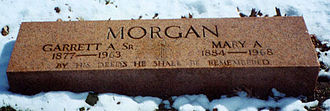
At the Emancipation Centennial Celebration in Chicago, Illinois, in Baronial 1963 (one month after his expiry), Morgan was nationally recognized.[3]
In the Cleveland, Ohio expanse, the Garrett A. Morgan Cleveland School of Scientific discipline and the Garrett A. Morgan Water Treatment Found have been named in his honor. An simple school in Chicago was also named subsequently him.[29] An elementary school bearing his name opened in the fall of 2016 in Lexington, Kentucky.[xxx] In Prince George's Canton, Maryland, there is a street named Garrett A. Morgan Boulevard (formerly Summerfield Boulevard until 2002) and the adjacent Metro finish (Morgan Boulevard) also bears his name.
Morgan was included in the 2002 book 100 Greatest African Americans by Molefi Kete Asante.[31]
Morgan is an honorary member of Blastoff Phi Alpha fraternity.[3] [32]
References [edit]
- ^ Bland, Karina. "ten-yr-old Julio is pedagogy his family about Black History Month". The Arizona Republic . Retrieved July 29, 2020.
- ^ Cook, Lisa D. (2012). "Overcoming Discrimination past Consumers during the Age of Segregation: The Case of Garrett Morgan". Business History Review. 86 (2): 211–234. doi:10.1017/S0007680512000372. ISSN 2044-768X. S2CID 73554424. Archived from the original on June nineteen, 2020. Retrieved June 5, 2020.
- ^ a b c d east f thousand h i "Biography of Garrett A. Morgan". OhioLink.edu. Archived from the original on May 27, 2015. Retrieved May 27, 2015.
- ^ "Claysville and Other Neighborhoods (Paris, KY)". Notable Kentucky African Americans Database. University of Kentucky. Archived from the original on May 27, 2015. Retrieved May 27, 2015.
- ^ a b c d e f grand "Morgan, Garrett A.". The Encyclopedia of Cleveland. A joint effort by Case Western University and the Western Reserve Historical Society. Feb 23, 2005. Retrieved February xi, 2013.
- ^ a b c d east Who Made America? Pioneers: Garrett Augustus Morgan Archived June fourteen, 2020, at the Wayback Automobile PBS.org.
- ^ "Morgan, Garrett A., Sr. · Notable Kentucky African Americans Database". nkaa.uky.edu . Retrieved Dec 10, 2018.
- ^ a b c Bianco, David (1992). "Morgan, Garrett 1877-1963". Encyclopedia.com. Archived from the original on May xviii, 2015. Retrieved May 27, 2015.
- ^ Gates, Henry Louis; Higginbotham, Evelyn Brooks (2004). African American Lives. Oxford University Press. ISBN9780199882861.
- ^ a b Cleveland Clan of Colored Men Archived September xx, 2016, at the Wayback Car, Encyclopedia of Cleveland History, Case Western Reserve University.
- ^ a b Garrett Morgan, Cleveland Inventor Archived April 21, 2019, at the Wayback Machine, ClevelandAreaHistory.com
- ^ a b c d due east f g h i j m l m n o p q r s Sisson, Mary (2008). "Garrett Morgan". In Cavendish, Marshall (ed.). Inventors and Inventions. Vol. 4. pp. 1101–1107. ISBN978-0-7614-7767-ix.
Later designs would include an airbag containing about 15 minutes' worth of fresh air.
- ^ a b c d e f g h Garrett Morgan Archived February 28, 2014, at the Wayback Machine, Black Inventor Museum.
- ^ "Garrett A. Morgan". Engineering and Technology History Wiki . Retrieved May 27, 2015.
- ^ "Hero of Crib Explosion Dies at 86". The Plain Dealer. July 28, 1963. p. AA6 ; "Death Notices". The Manifestly Dealer. July 29, 1963. p. 34.
- ^ a b c d Inventor of the Week: Garrett A. Morgan: The Safety Hood, MIT, February 1997.
- ^ Morgan, Garrett A. (March 24, 1914), Breathing device., archived from the original on October 20, 2016, retrieved May 23, 2016
- ^ Brewer, Mary Jane; Clevel, Special to; .com (Feb 12, 2020). "Curator speaks about Medina'southward Little Wiz Burn Museum". cleveland. Archived from the original on February 21, 2020. Retrieved July 29, 2020.
- ^ Time-Life Editors (1991). Inventive Genius . New York: Time-Life Books. p. 40. ISBN0-8094-7699-ane.
- ^ Morgan, Garrett A. (Oct 13, 1914), Breathing device. , retrieved May 23, 2016
- ^ a b "Garrett Morgan 1877-1963". Almost.com Famous Inventors.
Ii years later on, a refined model of his early gas mask won a gilded medal at the International Exposition of Sanitation and Safety, and another gilded medal from the International Clan of Fire Chiefs.
- ^ "22 Men Killed Under Lake Burn down" (On-Line Google News Archive). Lawrence Periodical-World. Vol. LX. Lawrence, Kansas. July 25, 1916. p. ane. Retrieved October 1, 2013. Note: This source for the tunnel fire makes no mention of Morgan by name, relieve "The 2d [rescue expedition] saved one of first rescue expedition"
- ^ "Inventions that Shook the Globe: The 1910s". Discovery Channel. Retrieved March 16, 2013. [ permanent dead link ]
- ^ A, Morgan Garrett (November twenty, 1923), Traffic signal, archived from the original on April 2, 2016, retrieved May 23, 2016
- ^ "The Cleveland Telephone call & Mail". The Encyclopedia of Cleveland History. Case Western Reserve University. Archived from the original on June 7, 2012. Retrieved January 28, 2015.
- ^ Gray, David (2012). The History of the Nearly Worshipful Prince Hall Grand Lodge of Ohio F&AM 1971–2011: The Fabric of Freemasonry. Columbus, Ohio: Nearly Worshipful Prince Hall Grand Club of Ohio. p. 157. ISBN978-0615632957.
- ^ DiCicco, Joan (2019). The Unstoppable Garrett Morgan: Inventor, Entrepreneur, Hero. New York: Lee & Low Books, Inc. p. 9. ISBN9781620145647.
- ^ Grabowski, John. "Morgan Garrett A." Encyclopedia of Cleveland History. Cleveland OH: Case Western Reserve University. Archived from the original on June 29, 2020. Retrieved July 19, 2020.
- ^ "Chicago Names School for Inventor Garrett A. Morgan". Jet. May 31, 1973. Retrieved May 27, 2015.
- ^ Garrett Morgan Uncomplicated website.
- ^ Asante, Molefi Kete (2002), 100 Greatest African Americans: A Biographical Encyclopedia. Amherst, New York: Prometheus Books. ISBN 1-57392-963-8.
- ^ "Prominent Members of Alpha". Alpha Phi Blastoff. Archived from the original on October 5, 2013. Retrieved May 27, 2015.
Further reading [edit]
- Elassar, Alaa (February 1, 2021). "Blackness History Calendar month – Profiles in perseverance. You may not know their names. Simply these courageous Black Americans changed history". CNN.
External links [edit]
- The Encyclopedia of Cleveland History—Waterworks Disasters
- Images from Morgan'due south patents
Source: https://en.wikipedia.org/wiki/Garrett_Morgan
0 Response to "Garrett Morgan Family John Hunt Morgan Garrett Morgan"
إرسال تعليق