Here We Go Again Green Screen

From bringing Jurassic World's all-too-real raptors dorsum from extinction to rendering Black Panther'due south Wakanda in dizzying detail, the use of light-green screens in the field of visual furnishings (VFX) helps create unbelievably "real" movie magic.
Using this special technique, two distinct images or video streams tin can exist layered (or, as the pros say, composited) together, assuasive filmmakers to put annihilation they can dream up on screen. Take a peek behind the scenes of your favorite Hollywood blockbusters to see what iconic moments await like before the VFX team works their magic. Spoiler: Information technology'south ridiculous!
Tiger and Scenery from Life of Pi
Directed past visionary filmmaker Ang Lee, 2012's Life of Pi earned more than than $609 one thousand thousand worldwide and clinched 4 of its 11 Oscar nominations. In the film, a immature Indian man named "Pi" Patel tells a novelist his life story.

At age 16, he survived a shipwreck and, afloat in the Pacific Bounding main, shared a lifeboat with a Bengal tiger — a.k.a. a lumpy, bluish screen-coated blimp animal. "Every shot was artistic exploration," said VFX Supervisor Beak Westenhofer. "To make the ocean a grapheme and make it interesting, we had to strive to brand information technology equally visually stunning as possible."
The fast-talking, (arguably) saltiest member of the Guardians of the Milky way is Rocket Raccoon. Smart and hands annoyed, he is voiced past Bradley Cooper, but all of his lines are recorded in a studio — far away from maquettes and green screens.
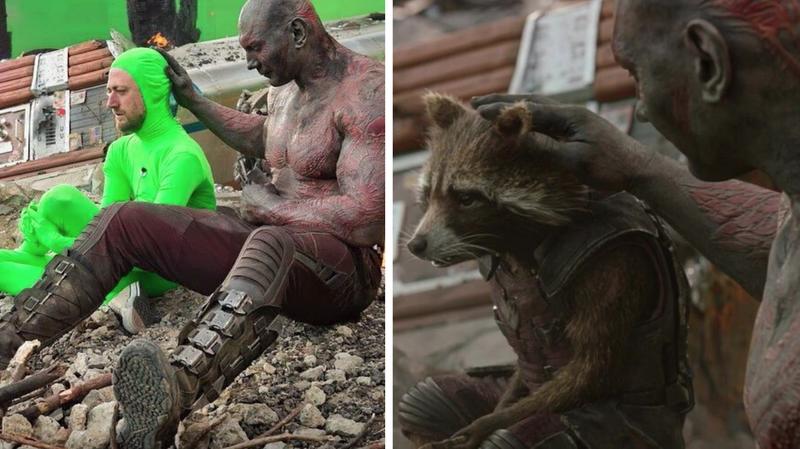
Much like wolf-Jacob from the Twilight Saga, Rocket has a homo stand-in instead of an inanimate prop. This means the other actors have someone to interact with, and every bit a bonus, VFX artists tin use the motion capture performers facial expressions and (sometimes) gestures if needed. In this scene, though, almost of the mo-cap performer was completely removed from the moving-picture show, thanks to that wear light-green screen.
Virtually Everything in Gravity
This 2013 space thriller was directed by Alfonso Cuarón and starred Oscar winners Sandra Bullock and George Clooney as astronauts who become stranded in infinite after their space shuttle is destroyed. Unsurprisingly, the seven-fourth dimension Academy Honour-winning pic cleaned up when it came to special effects.
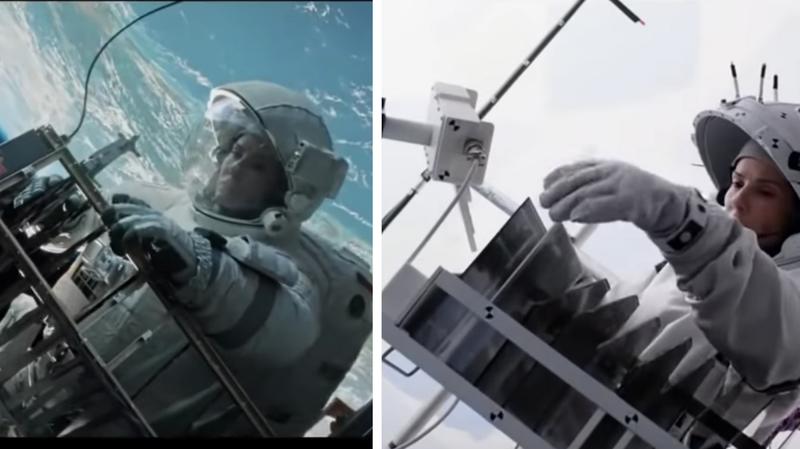
Every bit viewers watch Bullock struggle to return to World, they forget that most of what they're looking at is computer-generated. Co-ordinate to VFX supervisor Tim Webber, a staggering 80% of Gravity consists of CGI. Moreover, to simulate the manner unfiltered calorie-free in infinite reflects off objects, the effects team manually controlled a lighting system made of 1.8 one thousand thousand LED lights.
Dinosaurs in Jurassic Globe — Before
Sci-fi adventure moving-picture show Jurassic World (2015) is the fourth movie in the Jurassic Park series, which debuted manner back in 1993. Set 22 years after the classic Steven Spielberg film, Jurassic World holds to a like premise: A theme park full of cloned dinosaurs is plunged into utter anarchy when a dangerous dino escapes from its enclosure.

Although the film cost a whopping $150 million to brand, all those VFX dinosaurs paid off — literally. Jurassic World generated $ane.6 billion in box role revenue, making it one of the highest-grossing films of all time.
Dinosaurs in Jurassic World — After
In the original film, the VFX were done by George Lucas' Industrial Low-cal & Magic — the technical wizards responsible for the amazing visuals in the Star Wars films. A new applied science was introduced for Jurassic Park — Dinosaur Input Devices, which were models that fed information into computers, allowing them to animate the creatures like cease motion puppets.

Similar with the original films, Jurassic Earth relied on a mixture of animatronic dinosaurs and computer-generated ones. One added benefit? Move capture technology. In this scene, Chris Pratt's character wards off some raptors, which were "played" by actors in suits and shot against a light-green screen.
Heroics in Spider-Human: Homecoming
Even your friendly, neighborhood Spider-Human needs a helping hand at times. For Spider-Man: Homecoming, the VFX teams wanted to reach new heights and even studied translucent polar bear pilus to requite Spidey'south webs a realistic await.
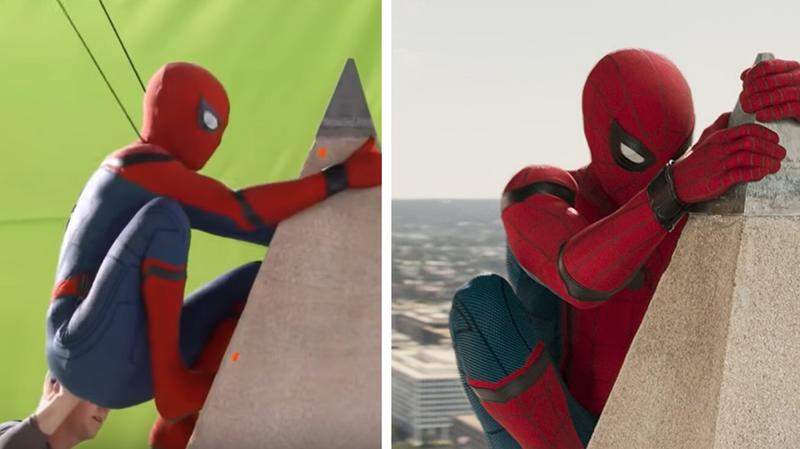
In social club to requite the film a different feel from the webslinger's previous forays, executive producer Victoria Alonso thought about doing away with Sony Pictures' ImageWorks, but later on being impressed by their piece of work, she enlisted the studio — alongside a dozen other VFX vendors. With more than 2,000 VFX shots in the moving-picture show, Alonso insisted that "collaboration was fundamental" — and she was correct.
The Wolves in the Twilight Saga
Whether you're "Team Edward" or "Team Jacob," you can definitely hold that this behind-the-scenes shot from the Twilight films is… uncomfortable. Bella Swan (Kristen Stewart) pats Jacob Black (Taylor Lautner) on the head — because that'southward way more than comfortable than patting a stand-in dog or a maquette, right?

For all of his wolf scenes, Lautner — whose grapheme shifts from human to canine form — donned a gray morph accommodate and acted out every wolf-like movement. In the age of mo-cap professionals, this is sort of surprising. Maybe Lautner is only really method to the core?
Mustafar Lightsaber Duel in Star Wars: Episode III – Revenge of the Sith — Earlier
The Star Wars prequel films clue fans into a lot of important information, only, above all else, they centre on Jedi Anakin Skywalker'south (Hayden Christensen) descent to the nighttime side. Episode III promised to transform the immature Jedi Knight into the legendary Darth Vader, which was no small feat.

Fans were waiting expectantly to see how Anakin would betray those closest to him — likewise as the Jedi Order and longtime mentor and pal Obi-Wan Kenobi (Ewan McGregor). In true Star Wars fashion, Anakin'due south journey ended in a legendary lightsaber fight to the death — sort of.
Mustafar Lightsaber Duel in Star Wars: Episode III – Revenge of the Sith — After
To prepare for the nearly viii-minute long sequence, McGregor and Christensen trained relentlessly to get the choreography down pat. Fighting with wooden dowels, the duo climbed effectually on wooden blocks and jumped from light-green object to light-green object.

In the terminal picture show, the duo fights on the lava-filled planet Mustafar, venturing from a landing pad to a control eye and and so out onto the mill ramparts, which teeter over streams of molten lava and burn. This makes the fight sequence — and the actors' portrayal — all the more impressive when you realize it was basically the ii of them batting at each other with sticks in a green room.
Josh Brolin's Thanos in Avengers: Endgame
In the Marvel Cinematic Universe, the ultimate "big bad" of the long-running collection of films ends up being Thanos (Josh Brolin), a destroyer of universes. Thanos searches the galaxy for the Infinity Stones, hoping to utilize their ability to magically snap away half of the universe's population.
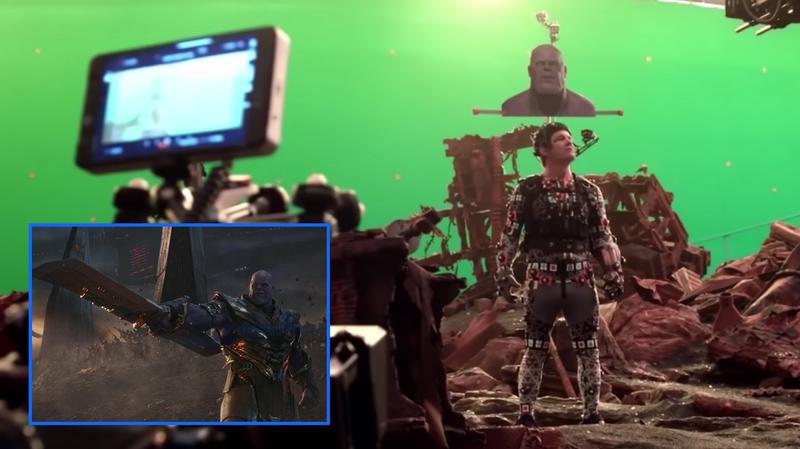
While we expected Brolin (or a trunk double) to wearable a pretty extensive move capture adapt to capture the hulking titan'southward mannerisms, nosotros didn't expect him to wearable a paper-thin cut-out of Thanos' head high above his ain. The reason for the foreign choice? It was a clever way to make certain the actors were looking at Thanos' face in the last cut.
Cyborg in Justice League
Of all the heroes in DC Comics' long-awaited Justice League, Cyborg (Ray Fisher) may exist the to the lowest degree known of the crime-fighting characters. Although he does appear as a member of the Justice League at times, Cyborg has more often been associated with the League'southward young adult counterparts, the Teen Titans.
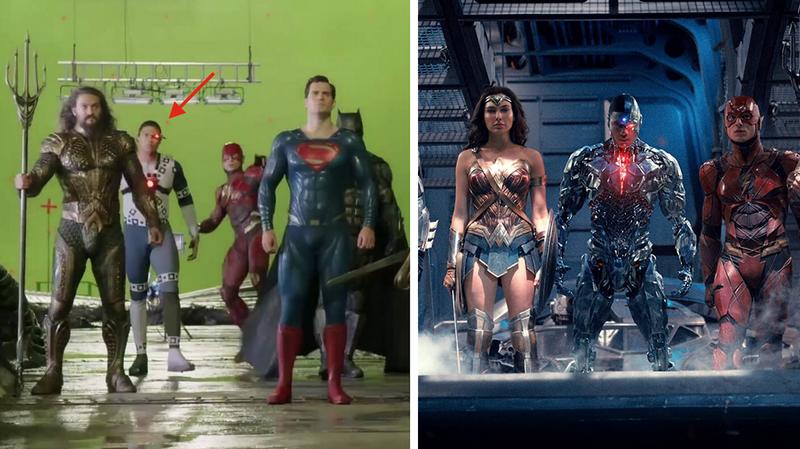
While nearly of the other heroes in the Justice League lineup got to don Amazonian armor, gauntlets from Atlantis and absurd, loftier-tech suits, Fisher put on a nifty motility capture adjust, complete with lights and colour-coded sections to make it easier for artists to animate all of Cyborg's moving parts.
Animal from Beauty & the Beast
Tale as one-time equally time, right? Well, maybe not. While other versions of this story rely heavily on practical makeup effects — or the pencils of talented Disney animators — the 2017 remake, which stars Emma Watson and Dan Stevens equally the titular duo, leans into movement capture.

On the left, Stevens dons a rather bulky motility capture conform, which leaves but his face exposed. The end outcome? A Fauna who is about all estimator-generated — save his eyes, which are the real thing. Allegedly, Disney felt this would give the character that "human element," but we can't help but feel his performance was a tad stiff.
Portals in Medico Strange
Compared to Helm America or Iron Homo, Doctor Strange is certainly ane of Marvel's less mainstream characters, but the character's mystical fourth dimension-space-angle powers allow for some pretty neat — and rather circuitous — visuals.

Nominated for a All-time Visual Effects Oscar, Physician Strange was described by cinematographer Ben Davis as "Curiosity's Fantasia," thanks to its psychedelic, Grand.C.-Escher-inspired imagery. Managing director Scott Derrickson echoed these thoughts, proverb that the mirror dimension chase was an attempt to take Inception "to the Nth caste… [make it] way more surreal." Thank you to greenish screens and some absurd lighting effects, the movie achieved that vision.
Quidditch in the Harry Potter Serial — Before
From the male child wizard slaying a basilisk to the main trio being attacked by behemothic, enchanted chess pieces, in that location's a lot of awesome technical (witchcraft and) wizardry to bespeak to in the Harry Potter series. Only who didn't desire to hop on a Firebolt broomstick and try their mitt at Quidditch?

Well, Radcliffe was glad to hang upward his broomstick when the time came. According to the young role player, the rigs were uncomfortable, and shooting scenes for matches took quite a lot of time, meaning he spent a lot of time dealing with discomfort on the annoying rig.
Quidditch in the Harry Potter Serial — After
When shooting a Quidditch match, the crew filmed each role player separately and from multiple angles. Subsequently, all that footage had to be pieced together to course a fluid game. Most actors used the mechanical rigs Radcliffe wasn't fond of, simply it meant filmmakers could command (or "steer") the "broom" for the shots.

Add in some artificial air current and the green (or blue) screen magic and presto — flying broomsticks. According to a behind-the-scenes featurette, a few other Quidditch scenes were shot using trampolines, which Ron Weasley player Rupert Grint said was "quite scary."
Fight Sequences in The Matrix — Earlier
Written and directed by the Wachowskis, 1999's cyberpunk activity film The Matrix took the globe by tempest. (Kind of literally?) The sci-fi masterpiece depicts a dystopian future in which humanity is unknowingly trapped inside a simulation of reality — a.g.a. the titular Matrix.
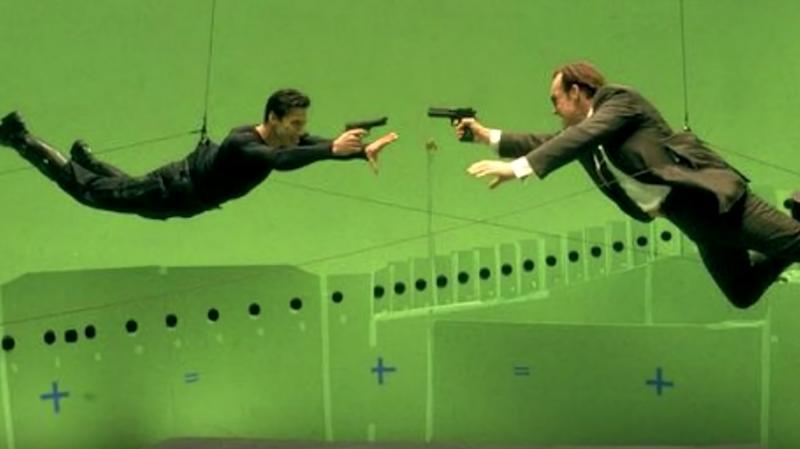
The simulation has been created past machines to distract humans from the fact that their bodies are being used equally an energy source. When Neo (Keanu Reeves) discovers the truth, he is pulled into a rebellion — i he might have to lead. In creating this stylish movie, the Wachowski's leaned heavily into the aesthetics of Japanese anime and martial arts films.
Fight Sequences in The Matrix — Later
In leaning into these visuals, the author/director duo likewise capitalized on the use of fight choreographers and the "wire fu" techniques that were popularized by Hong Kong action cinema. In add-on to using rigs and wires to create gravity-defying fights, The Matrix is also known for popularizing "bullet time."

In "bullet time," a character's heightened perception is represented by the action within a shot moving in slow-motility while the photographic camera moves at normal speed. Needless to say, this fun effect — and some CGI — allow for Neo to dodge bullets, and it paved the way for an on-screen depiction of Spider-Man's "Spidey sense."
Quicksilver'southward Speedy Antics in X-Men: Days of Hereafter By
In X-Men: Days of Hereafter Past, super-speedster Quicksilver (Evan Peters) puts his powers on full display during one of the film'south most memorable scenes, where he dashes around the Pentagon kitchen to reposition and disarm the guards pursuing him and his accomplice.

Everything around Quicksilver moves in seeming slow-motion to emulate his betoken of view, so before Wolverine (Hugh Jackman) can even fully extend his claws, the speedster already makes quick work of the enemies. For the sequence, Peters was filmed running in place, allowing him to act out all of Quicksilver's antics to a "T." Afterwards, the VFX team added in loads of CGI props, from bullets to frying pans, all of which had to be choreographed perfectly.
All Those Fight Sequences in 300: Rise of an Empire
"This. Is. Sparta!" And by "Sparta," we mean the land of dark-green screens. In 300: Rise of an Empire, the film keeps the stylistic flair of its predecessor — besides as what can best exist described every bit a filter those who are new to Instagram run all their posts through.

Jokes bated, Rising of an Empire is a visual treat. This boxing on a ship takes place in a greenish room where prop masters built only the ship's flooring. Yous'll notice the green "X's" on the ground, which helped actors hit their marks, and VFX artists removed that pesky record in mail service-production.
THAT Final Battle in Avengers: Endgame — Before
A 21 flick lead-upwards meant that the anticipation for Avengers: Endgame was high — dangerously high. Nosotros all knew it would end in a climactic battle, just, somehow, the folks behind the Curiosity Cinematic Universe exceeded our wildest expectations.

Throngs of recognizable characters from the terminal decade of films filled the screen in the final confront-off confronting Thanos (Josh Brolin). Getting all the characters together took a lot of wizardry — both in terms of the motion-picture show'due south actual plot and in terms of the actual VFX processes backside the scenes.
THAT Terminal Battle in Avengers: Endgame — Later on
1 of the almost exciting shots shows Tessa Thompson's Valkyrie, a character introduced in Thor: Ragnarok, on her trusty winged steed. In reality, that horse was just a saddle-like structure that allowed for a scrap of movement, supported by some folks dressed in dark-green suits.
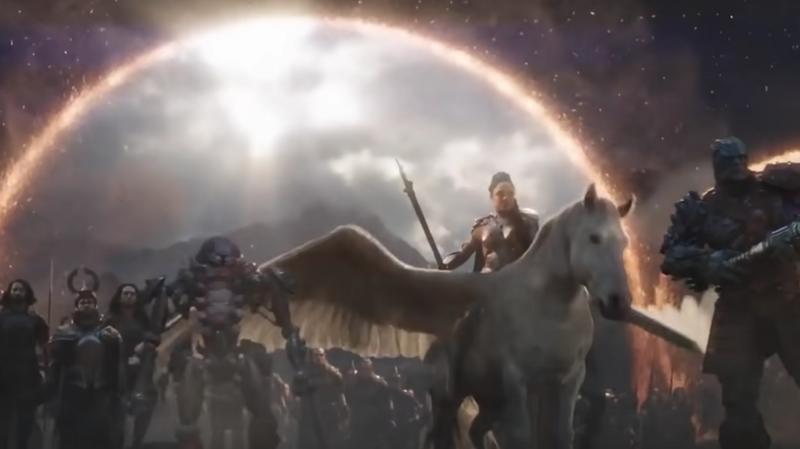
Other characters besides as the Doctor Strange portal effect and the sun-punctured heaven behind Valkyrie and her cohorts were all added, thanks to the help of a trusty greenish screen. In fact, all of the Avengers assembled in a behemothic greenish room and just executed a lot of cool fight choreography. The VFX team transformed that gaping room into a battlefield for the ages.
Luke Skywalker's Robotic Manus in Star Wars: Episode VIII – The Last Jedi
In Star Wars: Episode V – The Empire Strikes Back, Luke Skywalker loses his paw during a lightsaber duel with Darth Vader. In that same iconic scene, the Sith Lord as well reveals that he's Luke'southward father. In many ways, Luke'due south on-screen portrayal changed from that signal forrad.

Although he's fitted with a robotic paw and a skin-graft in the original films, Luke becomes less interested in hiding his metal phalanges in Episode VIII. In club to capture the look and motility of the hand just correct, VFX artists fitted Marker Hamill's joints with these crafty green bands.
Function Panthera leo in The Wolf of Wall Street
Martin Scorsese's 2013 dark one-act law-breaking picture show The Wolf of Wall Street is based on Hashemite kingdom of jordan Belfort'southward memoir of the aforementioned name. In it, Belfort recounts his career as a New York Urban center stockbroker and the ways in which his firm, Stratton Oakmont, engaged in immoderacy, corruption and fraud.

The Oscar-nominated film became Scorsese'due south highest-grossing moving picture, simply it wasn't without controversy. Different Life of Pi's tiger, the lion that padded around the depraved office was the real deal, which drew complaints. While shooting, a handler walked the leashed lion effectually an empty office. Afterward, the handler was edited out, and the office employees were added in.
The (Film-Long) Auto Chase in Mad Max: Fury Route
Technically, Mad Max: Fury Road is kind of the anti-green screen motion picture. Managing director George Miller has stated that 90% of the effects in his post-apocalyptic masterpiece are practical. With droves of modified hot rods, loads of camera rigs and more 150 stunt performers, Fury Route was filmed on location in Australia.

"Equally far as I know, the only VFX on our costumes was the light-green glove [Charlize Theron] wore to hide her arm," said costume designer Jenny Beavan. "And they also took out wires from the [stunt] harnesses." Due to the harsh filming conditions, VFX were by and large used to alter the time of 24-hour interval, terrain and weather effects.
Jar Jar Binks in Star Wars: Episode I – The Phantom Menace
Clumsy simply well-intentioned, Jar Jar Binks tried to bring some levity to the prequel films, merely for many viewers, he wasn't lovable at all. Even so, bringing the Gungan to life — CGI natural language and all — was a real feat for the ILM VFX squad.
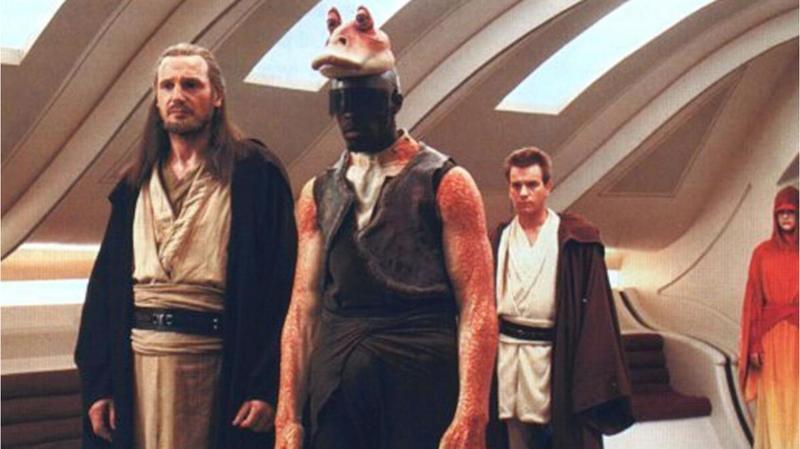
Ahmed Best, who provided Jar Jar's voice and motion capture performance, had a fun time filming Episode I, even with the Jar Jar maquette on his caput. Although fans' unwarranted dislike led to some night times in Best'south life, he could take solace in the fact that at least his face wasn't associated with the much-hated character.
The Android in Ex Machina
Like Mad Max: Fury Route, Ex Machina defines our typical VFX expectations. In this psychological sci-fi thriller from writer/director Alex Garland, a programmer (Domhnall Gleeson) is invited by his CEO (Oscar Isaac) to administer the Turing test to an intelligent robot (Alicia Vikander) to decide her level of humanity.

Made with a budget of just $xv million, Ex Machina ended up winning the Oscar for Best Visual Effects. Impressively, during filming, the crew didn't utilize whatever light-green screen or tracking markers. Instead, scenes were filmed both with and without Vikander, allowing post-production teams to digitally pigment out the parts of her that the android body wouldn't need.
Ballad Danvers' Flight in Captain Marvel and Avengers: Endgame
In 2019, Captain Marvel became the first female-led superhero film to pass the billion-dollar mark. Although Brie Larson's Captain Marvel (a.thousand.a. Carol Danvers) doesn't require the makeup that other non-human characters require, she nonetheless gets her fair share of VFX back up.

For one matter, the flying sequences are all done against green screens, with Larson hooked upwardly to various rigs and wires that allow her to perform acrobatic stunts — or be "puppeteered" by the trusty stunt squad. In some sequences, Larson's hair is even digitally added in to give it all those floaty, glowing effects.
Wonderland and Its Inhabitants in Tim Burton'southward Alice in Wonderland
Tim Burton'southward 2010 Alice in Wonderland kicked off quite a few trends. Get-go, information technology helped usher in the age of darker, gritty reboots. Second, information technology boot-started a trend of live-action fantasy films existence greenlit past Disney. Third, information technology cemented Burton's commitment to making unabridged fantasy worlds using CGI and light-green screen furnishings.

While certain elements of the set up were created past designers, most characters and backdrops were dreamed up entirely in post-production. Instead, filmmakers crafted some pretty inventive light-green screen and mo-cap suits, including the thin-legged, bulbous suits seen here, which were used for Tweedle Dee and Tweedle Dum.
All Those Gritty Fight Sequences in Superman 5 Batman: Dawn of Justice
It'southward a bird. It'south a plane. It'south — a lot of dark-green screens. Superman has been around for quite some time, and back in the day, those Christopher Reeve films featured some pretty obvious composite backgrounds — a.k.a. flying Kal-El and Lois Lane were essentially pasted over background footage.

Now, much like Helm Marvel, Superman's power of flying happens courtesy of some inventive rigs and cables and CGI backgrounds. In Superman v Batman: Dawn of Justice, fans can grab a whole lot of flying fun and some great fight scenes, nigh of which were shot confronting dark-green screen backgrounds before being transformed into gritty, dark setpieces.
Kylo Ren and Luke Skywalker'south Duel in Star Wars: Episode 8 – The Final Jedi
Rian Johnson'southward entry in the Star Wars sequel trilogy brought some of the saga'south most thrilling setpieces to life. From Admiral Holdo's (Laura Dern) sacrificial starship maneuver to Rey (Daisy Ridley) and Kylo Ren'due south (Adam Commuter) lightsaber battle team-up, The Last Jedi is full of flair.

When Kylo Ren faces off against his uncle and former Jedi Master, Luke Skywalker (Mark Hamill), on the ruby-red common salt planet of Crait, the snow-like salt is a practical result — while the rest of the planet is rendered in post. Unlike the Star Wars prequels, which saw actors using wooden dowels every bit sabers, the sequel trilogies upgraded things a bit.
Source: https://www.ask.com/entertainment/hollywood-blockbuster-moments-green-screens?utm_content=params%3Ao%3D740004%26ad%3DdirN%26qo%3DserpIndex
0 Response to "Here We Go Again Green Screen"
إرسال تعليق