The Life of Animals in Japanese Art

Unknown artist, Haniwa Horse, Kofun period, 6th century, earthenware, Los Angeles County Museum of Fine art, Gift of the David Bohnett Foundation, Lynda and Stewart Resnick, Camilla Chandler Frost, Victoria Jackson and William Guthy, and Laurie and Neb Benenson
1 of 23

Kannon is the Buddhist deity of compassion and mercy. Here, the sculpted horse on his caput signifies that he is as well a protector of animals and those reborn in the animate being realm. With 3 eyes, three heads, and six arms, this Kannon is omniscient, all-knowing, and fix to rush to the assist of any beast needing his protection. His trigger-happy expression signifies his power to conquer all evils. Fabricated a k years ago, it is the oldest-known wooden sculpture of this deity in Japan.
Unknown Creative person, Seated Horse‑Headed Kannon, Heian catamenia, 11th century, woods, Yamakado Jichikai
2 of 23
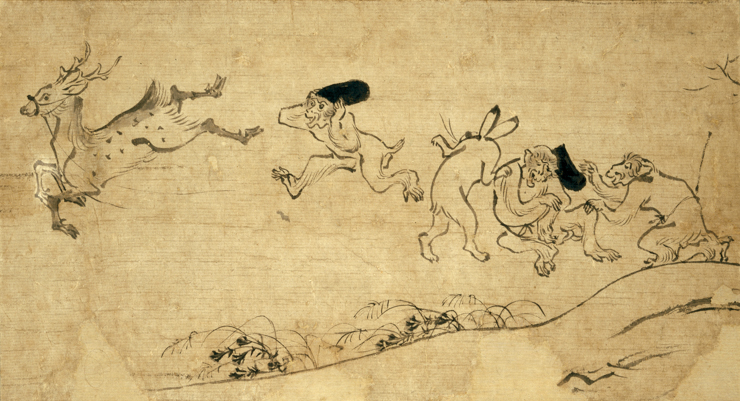
Here monkeys sporting the tall hats favored by the nobility take role in a race; one monkey has patently fallen off the runaway deer and is consoled by a rabbit and another monkey. This scene was discrete at an unknown appointment from a gear up of handscrolls featuring caricatures of animals endowed with homo traits. The scrolls' purpose is a mystery, equally no texts back-trail the images. They may be the outset use of animals to satirize contemporary society, or even the ancestor of modern Japanese manga comics. The handscrolls are preserved at Kozanji, a Buddhist temple near Kyoto, and designated a National Treasure by the Japanese authorities.
Unknown artist, Monkeys, from the handscroll Frolicking Animals, Heian–Kamakura periods, 12th–13th century, department mounted every bit a hanging scroll, ink on paper, Collection of Robin B. Martin
three of 23

This sculpture commemorates the arrival of a kami on a cloud-borne deer at Kasuga Taisha, a Shinto shrine near Nara dating to the eighth century. Rising from the deer's dorsum is a sakaki tree, an evergreen sacred to Shinto. Engraved on the disc or mirror in its boughs are images of the 5 Buddhist deities worshipped at Kasuga Taisha'south five shrines, evidence of the fusion of Shinto and Buddhist beliefs. The artist rendered the deer and sakaki tree in realistic particular, even including insect-chewed leaves.
Unknown Artist, Deer Begetting Symbols of the Kasuga Deities, Nanbokuchō era, 14th century, bronze, wood with pigments, Hosomi Museum, Kyoto
iv of 23
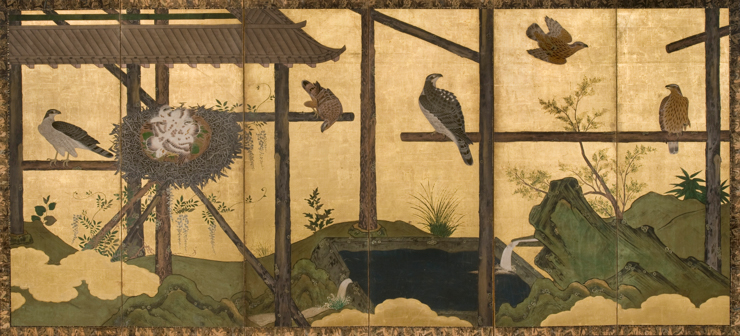
Falconry (hunting with birds of prey) was a sport favored past shoguns and loftier-ranking samurai. This unusual screen presents hawks "off duty" in the well-appointed mews where they were housed during their molting season, identified as summer by the flowering wisteria. With birds of various ages silhouetted against a golden ground and chicks in an artificial nest, this peaceful, almost domestic scene represents powerful goshawks less as predators than as evocations of the stability of the Tokugawa government.
Kanō School, Goshawk Mews, Edo period, c. 1675, vi‑panel screen, ink, colour, and gold leaf on paper, Philadelphia Museum of Fine art: Souvenir of Mr. and Mrs. Douglas J. Cooper, 1978
five of 23

Standing on its toes and coyly bending its paws, the shape-shifting play a trick on portrayed in this netsuke is in the middle of a wily transformation. In folklore, foxes are tricksters who turn into attractive women to seduce unwitting men.
Unknown Creative person, Dancing Fox, Edo flow, 18th century, ivory with staining, Los Angeles County Museum of Art, Raymond and Frances Bushell Collection
6 of 23
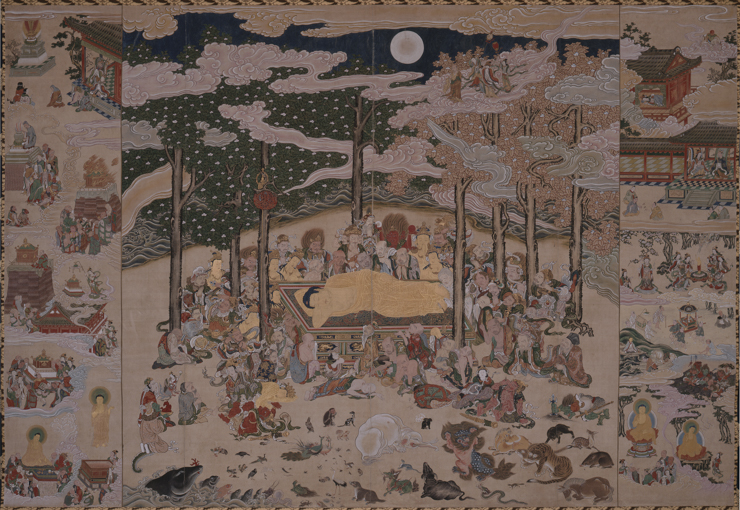
Shaka is the Japanese proper noun for the historical Buddha, who lived and died in India in the 6th century BC. On learning of his expiry, all living beings gathered at his side to mourn his passing into the blessed state known as Nirvana. Here, Shaka lies on his funeral bier, already transformed into a deity of superhuman size. His mother, Maya, flies in on a cloud at upper right, while deities, disciples, and both real and imaginary animals limited various stages of grief. The central image of mourning is flanked by scenes illustrating important events in the Buddha'southward life. Large hanging scrolls such as this are used for the almanac Buddhist rite in memory of Shaka's passing.
Unknown Artist, Shaka Passing into Nirvana, Edo menstruum, 1727, hanging curl, ink and color on silk, Seiraiji, Aichi Prefecture
7 of 23

The circuitous poses of these two cranes, ane encircling the other, are typical of Jakuchū's unconventional approach to traditional subjects. His subtle layering of pigments captures textures ranging from stiff pino needles to soft plumage. Cranes—idea to live for a 1000 years—and evergreens both symbolize longevity. Probably painted for utilize in New Year's Day celebrations, the scroll depicts the cranes at dawn, greeting the start sunrise of the year.
Itō Jakuchū, Pair of Cranes and Morning Sun, Edo catamenia, c. 1755–1756, hanging scroll, ink and color on silk, Tekisuiken Memorial Foundation of Civilization, Chiba Prefecture
8 of 23

Made for the daughter of a wealthy merchant, this wedding ceremony garment features a large phoenix, mythical king of the birds, spreading its wings over peacocks, doves, pheasants, parrots, and chickens. In Nippon, the number 1 hundred is normally used generally to signify abundance, but here it is literally truthful.
Unknown Artist, Uchikake with Phoenix and Birds, Meiji period, 19th century, silk crepe, paste‑resist dyed, Kyoto National Museum
9 of 23

The Buddhist sculptor Kōun turned to secular subjects during the Meiji period, when Buddhism was suppressed in favor of the native Shinto faith. He borrowed an actual monkey used equally an allure at a teashop to study while creating this dramatic, dynamic sculpture. It won a gold medal when exhibited at the 1893 World's Columbian Exposition in Chicago, and it has been designated an Of import Cultural Property past the Japanese regime.
Takamura Kōun, Aged Monkey, Meiji period, 1893, wood, Tokyo National Museum
ten of 23

Kusama Yayoi, Shō‑chan, Heisei menses, 2013, fiberglass‑reinforced plastic, paint, Individual collection
11 of 23
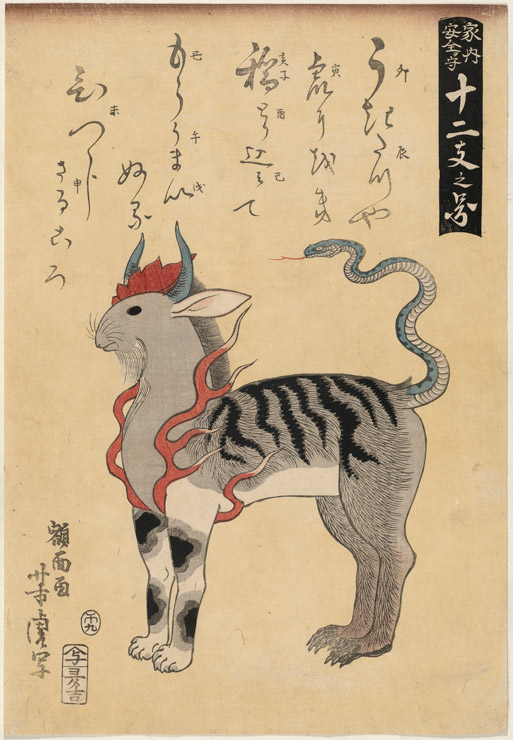
Utagawa Yoshitora, Picture of the Twelve Animals to Protect the Safety of the Dwelling house, Edo menstruum, 1858, woodblock print, Museum of Fine Arts, Boston, William Sturgis Bigelow Collection
12 of 23

Ogata Gekkō, Monkey Reaching for the Moon, Meiji period, c. 1890 – 1910, woodblock print, Arthur M. Sackler Gallery, Smithsonian Institution; Robert O. Muller Collection, S2003.8.1669
13 of 23

Kōen, Monju Bosatsu Seated on a Lion with Standing Attendants, Kamakura menses, 1273, set of five statues; wood with pigments, metal leaves, crystal eyes, Tokyo National Museum; Of import Cultural Property
xiv of 23

Miyagawa Kōzan I, Footed Bowl with Practical Venereal, Meiji catamenia, 1881, stoneware with brownish glaze, Tokyo National Museum; Important Cultural Property
fifteen of 23
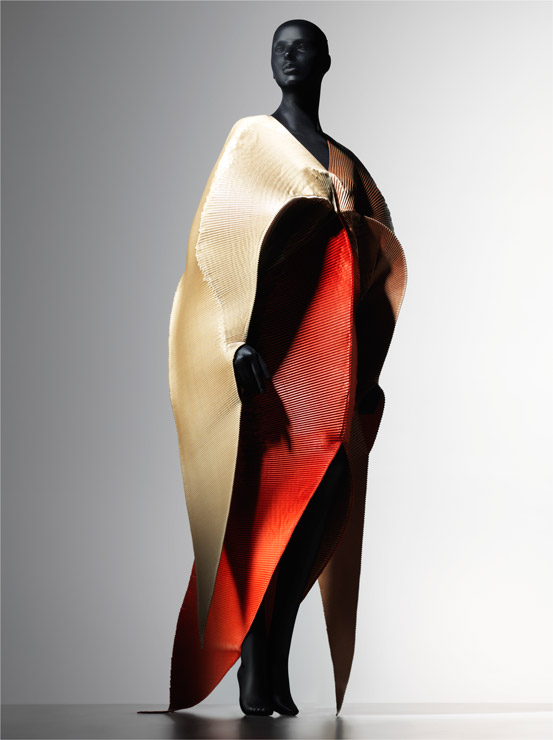
Issey Miyake, Swallow Pleats, Heisei period, 1999, polyester, Miyake Design Studio
16 of 23

Unknown artist, Sacred Foxes, Kamakura period – Nanbokuchō era, 14th century, wood with pigments, Kiyama Jinja, Okayama Prefecture
17 of 23

Unknown artist, Kyōgen Monkey Mask, Edo flow, 17th – 18th century, wood, gesso, pigments, Tokyo National Museum
18 of 23

Unknown artist, Charger with Bother Ascending Waterfall, Edo menstruation, 19th century, Arita ware, porcelain with celadon coat and underglaze blue, Segawa Takeo
19 of 23

Unknown creative person, Yogi with Crane and Turtle, Edo period, 19th century, silk crepe, paste-resist dyed, Matsuzakaya Collection
20 of 23

Kaigyokusai Masatsugu, Wild Boar, Edo – Meiji periods, mid-to-late 19th century, netsuke; ivory with ink, inlays, Los Angeles County Museum of Art, Raymond and Frances Bushell Collection
21 of 23

Nawa Kohei, PixCell-Bambi #14, Heisei period, 2015, mixed media, Collection of Ms. Stefany Wang
22 of 23

Unknown artist, Helmet Shaped like a Turbo Shell and Half Mask, Edo period, 17th century, atomic number 26, gold, silverish, wood, newspaper, lacquer, silk, hemp, horse pilus, Tokyo National Museum
23 of 23
mallettdoure1939.blogspot.com
Source: https://www.nga.gov/features/slideshows/the-life-of-animals-in-japanese-art.html
0 Response to "Haniwa Horse Is There a Symbol of Japanese Art"
إرسال تعليق